Overview
The ANU Law Internship Program offers Bachelor of Laws (Honours), Juris Doctor, Master of Laws and Master of International Law and Diplomacy students an opportunity to learn from leaders in the profession, gain experience in the broad spectrum of practice, deepen their awareness of potential career opportunities and carry out a law-based research project in a legal professional workplace for credit towards their degree.
Designed to help students realise the potential of their university learning through real-world application and workplace research experience, the program offers placements with a variety of partnered organisations such as government departments and agencies, private law firms and companies, legal aid, legal advocacy and community law providers, and non-government organisations. Internships are flexible and enable students to be hosted in face-to-face operational or research-focused roles or virtually in a research-intensive capacity.
Why host an intern?
ANU attracts exceptional students who are passionate about justice and using their knowledge to make a positive contribution to the world.
For hosts, this program is an opportunity to:
- Access and evaluate potential future talent from a pool of high-achieving law students;
- Gain fresh perspectives, ideas and innovation on new and existing projects;
- Develop lasting relationships and enhance their profile with talented and committed law students;
- Mentor and shape the next generation of law professionals;
- Increase their familiarity with the research and teaching expertise at ANU Law and open creative avenues for longer-term institutional collaborations.
Nature of internship
The nature of the work conducted by the intern will depend on the organisation. Host organisations are expected to provide an authentic work experience which means the type of tasks for each intern will vary from placement to placement. Interns may spend time shadowing members of staff in various roles and engaging in observational learning, while contributing in an assisting capacity to a range of law-related or legal research activities. Interns may also be asked to participate as a team member on a research project for the duration of the internship – an ongoing project or one that is completed during the internship. Interns may be assigned to an individual research project working under direction, which can be completed during the internship. Alternatively, the placement may be a combination of these activities.
Internships can be undertaken in-person, remotely or in a hybrid mode, depending on the needs and location of the host organisation.
For more information regarding unpaid internships, please refer to the Fair Work factsheet here: Fair Work Ombudsman factsheet on unpaid work.
Role of professional supervisor
The host organisation must provide the student with a professional supervisor who has a legal background and/or professional experience in the legal field (e.g. legal counsel, solicitors, barristers, mediator, arbitrator, government official, etc.).
The professional supervisor is responsible for supervising the activities of the student during the internship and ensuring that the student has a meaningful workplace experience in accordance with the expectations and protocols of the workplace, the legal profession and the ANU.
Professional supervisors are strongly encouraged to assist their students in developing their research projects where possible; however, this is not a mandatory requirement.
Duration and dates of internship
Student placements are expected to involve approximately 96 hours across the semester or session.
During Semester 1 and Semester 2, we expect students to complete 96 hours within 12 weeks (roughly equivalent to one day a week in the workplace). Note that students may have limited availability due to their other academic commitments in this period.
During intensive Winter and Summer periods, the distribution of the 96 hours is negotiable between the internship host and the student. Outside the semesters, students tend to have greater availability and therefore may be able to commit to two or more days per week in the workplace. Additionally, students can undertake the placement hours in an intensive two to three-week block.
Key Dates
The table below details the typical registration and placement dates for each regular internship period throughout the year.
| Internship Periods | Host Registrations | Placement Dates |
|---|---|---|
| Summer | Under review for 2028 (not available for 2027) | December to February |
| Semester 1 | Submit by late September | February to May |
| Winter | Under review for 2027 | June to July |
| Semester 2 | Under review for 2027 | July to October |
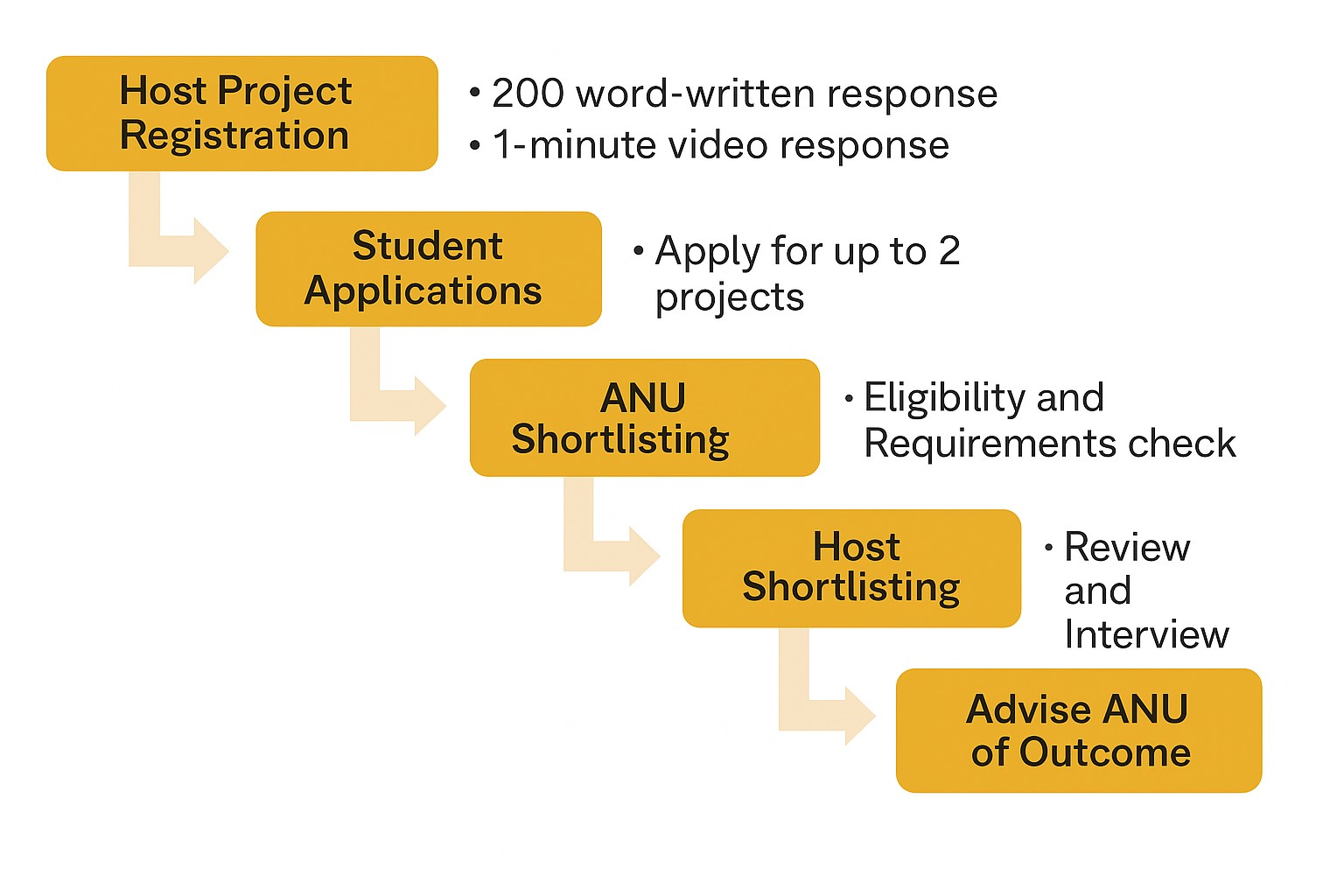
ANU Careers and Employability (Government and Law Hub) will manage the registration and application process based on the host’s professional needs and requirements.
Hosts will be provided with eligible applications, and they can select any number of intern(s) depending on their supervising capacity. Hosts may conduct interviews with their preferred candidates, if they wish, to help with the decision-making process. Even if a host registers an opportunity, they are not obligated to take a student if none are deemed suitable.
Hosts will provide their selection to ANU Careers and Employability (Government & Law Hub) who will manage all outcomes and paperwork.
Assessment
The internship attracts a course credit, and in addition to the placement, students will be expected to undertake assessment tasks and other academic components to successfully complete their course. Assessment is the student’s responsibility, coordinated by the ANU College of Law, Governance and Policy.
The primary academic assessment item is a research project that the student must develop, research and draft. The research project may be a topic of the student’s choice and may be multi-disciplinary, but it must have a strong law element and must relate to their placement tasks and workplace. Detailed assessment requirements can be provided upon request.
Legal Requirements
Internship Agreement
For unpaid interns, the host organisation is required to sign the ANU Host Placement Agreement which, among other things, addresses Intellectual Property (IP), confidentiality, insurance and the obligations of all parties. The relevant agreement will be forwarded to the host organisation as they engage in the Internship Program. An ANU Host Placement Agreement can last up to three years and be used for an unlimited number of interns.
Students undertaking an ANU approved internship are covered by ANU insurance which includes personal accident and travel cover.
Employed Interns
Host organisations can also employ students for the duration of their placement. In these cases, a non-ongoing/temporary employment contract will need to be negotiated between the host organisation and the student. Where a student is employed, the host organisation will be asked to sign an 'Employee Letter' for ANU, which clarifies the obligations of all parties and accurately reflects the student's role within the organisation.